Decking
The boards you walk on, usually made from wood, composite, or PVC.
Plan Your Deck The Smarter Way
Wondering what holds a deck together? Explore the picture below to see the main parts of a deck and what each one does.
A deck is made of several parts that work together. These include decking, joists, beams, ledger or freestanding supports, rim joists, fascia, railing, posts, and footings. Some parts hold up the deck, while others create the surface you walk on or help keep you safe. Select a component name to see what it does.
Choose a component from the buttons below the image to view its description. On desktop you can also select a labeled part of the illustration. This is a learning guide, not a construction plan.
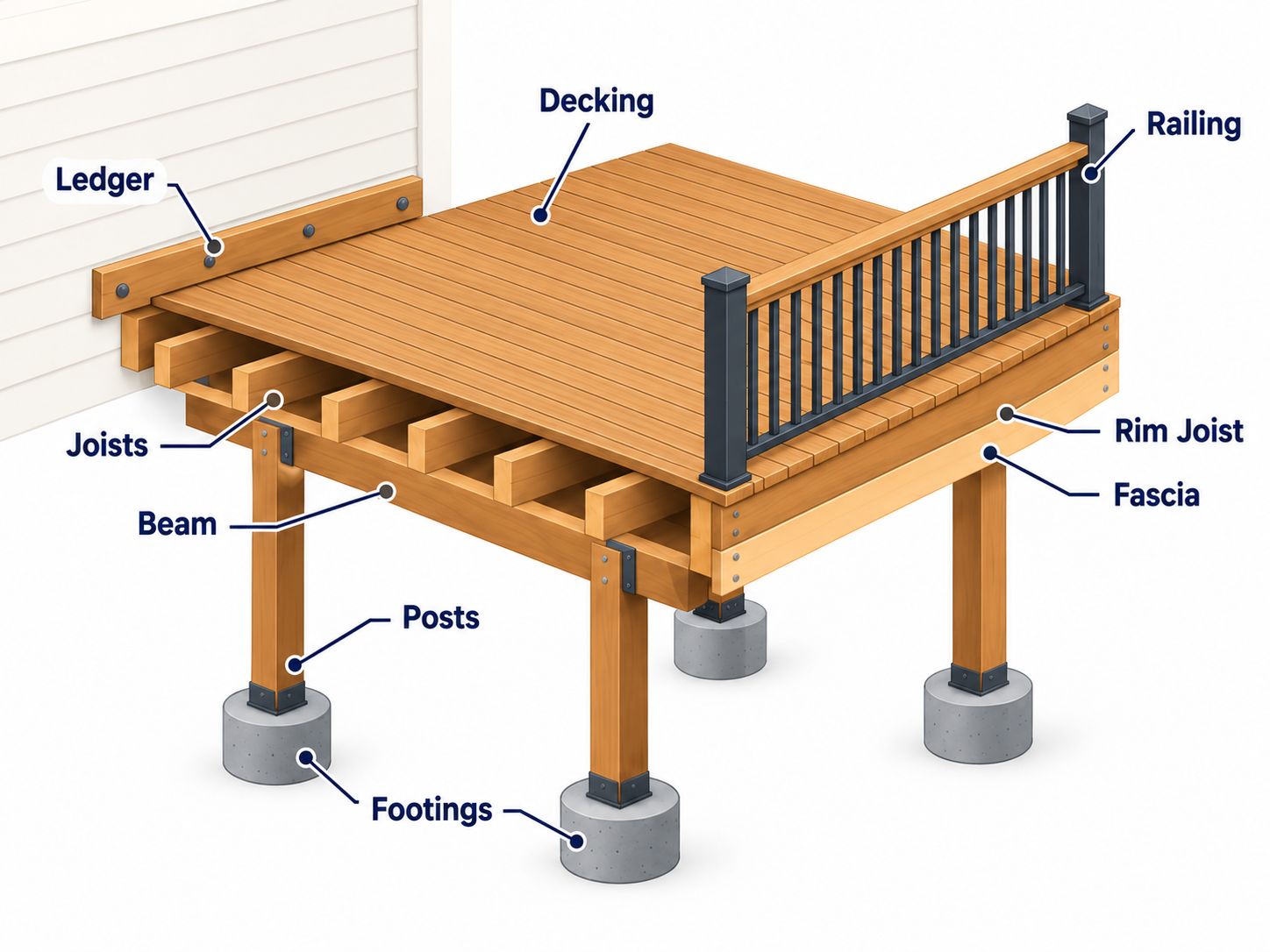
Illustration for education only. Actual deck assemblies, attachment methods, and requirements vary.
The long boards underneath your deck boards.
Most decks use the same basic parts, even when their size, shape, and materials are different.
The boards you walk on, usually made from wood, composite, or PVC.
The long boards underneath your deck boards. Joists help support the deck boards and rest on beams or other supports. Check that the joists line up before installing deck boards. See our guide to level deck joists.
Thicker support boards that sit below the joists and rest on posts. The beam’s size depends on the deck’s design and how far apart the posts are.
A board that connects an attached deck to the house. It needs a strong, weatherproof connection to the house. Some decks are built to stand on their own instead.
Boards that run around the outside edges of the deck’s frame. They connect the ends of the joists and help keep the frame together.
Upright supports that hold up the beams and deck above. The number and placement of posts depend on the size and design of the deck.
Concrete supports in the ground that help keep the deck steady. The size and depth of the footings depend on your soil, local weather, and building rules.
The barrier around the edge of a raised deck that helps prevent falls. Local building rules determine where railing is needed and how it should be built.
A finishing board that covers the outside edge of the deck frame. Fascia hides framing and gives the deck a neat finished look.
When you stand on a deck, your weight is supported by the boards under your feet, the wood framing below them, and the posts and concrete supports underneath. If the deck is attached to the house, a ledger board may also help support it.
Every deck is different. Our estimator can help you plan materials, but a qualified builder should confirm what your project needs.
Explore the Material Estimator →Joists sit directly under the deck boards. Beams are the larger supports underneath the joists, often resting on posts.
No. Some decks stand on their own posts instead of attaching to the house. A builder can help determine which option works for your home.
A pier is a concrete support that rises toward the deck post. A footing is the wider base that helps spread the deck’s weight into the ground. Sometimes they are poured together.
No. Deck Way gives you an early materials estimate to help you plan. Before you build or buy materials, have a qualified professional check measurements, structural needs, permits, and local building rules.
Water can damage the wood where a deck meets the house or around its frame. Flashing and other water-protection materials help keep moisture away. The right solution depends on your deck.
Now that you know the parts of a deck, try our free planner to explore layouts and get an early materials estimate.